

On this page
A common mistake with a letter before action is treating it as a stronger reminder: a week to pay, a threat of court, and nothing else. If your customer is a homeowner or a sole trader in England and Wales, the Pre-Action Protocol for Debt Claims expects a proper letter of claim with set enclosures and 30 days to reply. A letter that skips those steps can cost you later, because the court looks at what you did before the claim when it decides costs and interest.
This letter before action template comes in two versions: a letter of claim for homeowners and sole traders, and a shorter letter for limited companies and other business customers. Below each one is what to enclose and how long to give, then how to handle the replies, the mistakes to avoid and a filled-in example. For the reminders that come first, and the court and Small Business Commissioner routes that come after, see the guide to invoicing and chasing late payment.
Which letter you need: homeowner or business
The customer decides which rules apply, not the size of the bill.
The Pre-Action Protocol for Debt Claims applies when any business, including a sole trader, claims a debt from an individual, and that includes a customer who is a sole trader. So a homeowner, a private landlord who owns property in their own name, and a self-employed customer all get the full letter of claim. The protocol doesn't apply to business-to-business debts unless the customer is a sole trader.
For a limited company, a limited liability partnership or a letting agency trading as a company, the Practice Direction on Pre-Action Conduct applies instead. It asks for a letter with concise details of the claim, and gives the customer a reasonable time to reply: 14 days in a straightforward case.
If you're a subcontractor chasing a main contractor under a construction contract, a separate protocol for construction and engineering disputes applies. That's outside the scope of this guide, so take advice before you write.
Both sets of rules are for courts in England and Wales. If your customer is in Scotland or Northern Ireland, check the rules there before relying on the timings here.
Letter of claim template for homeowners
Put the letter on your normal letterhead, with your business name, address, phone and email. Date it near the top of the first page, because the 30 days run from that date. Fill in the square brackets and delete any line that doesn't apply.
If the job was priced on our quote template for trade work, its reference, version and acceptance date give you the agreement details for the second paragraph. Keep the tone flat and factual. The letter may be read later by a mediator or a judge, and a calm letter that sets out the facts helps you more than a strongly worded one.
What to enclose with a letter of claim
The protocol lists what the letter of claim should say and what goes with it. The letter itself should give the amount of the debt, whether interest or charges are continuing, the details of the agreement, how the debt can be paid and how to discuss payment options, and the address for the Reply Form. If the customer has already offered instalments that you're not accepting, say why.
Three things go in the envelope with it:
- An up-to-date statement of account, or the most recent statement plus any interest and charges added since. For most trades this is a one-page list: the invoice, any part payments and the balance.
- The Information Sheet and Reply Form from Annex 1 of the Pre-Action Protocol for Debt Claims. Print them from the protocol rather than writing your own, so nothing is missing.
- A Financial Statement form, which lets the customer set out their income and outgoings if they need time to pay. The protocol includes an example at Annex 2.
Keep a copy of everything you send, with the date you posted it. If you have the original quote and the signed job sheet, keep those with it too. Our job sheet template for trade visits shows how to record what was done and the customer's sign-off, which is the evidence you'll lean on if the customer disputes the work.
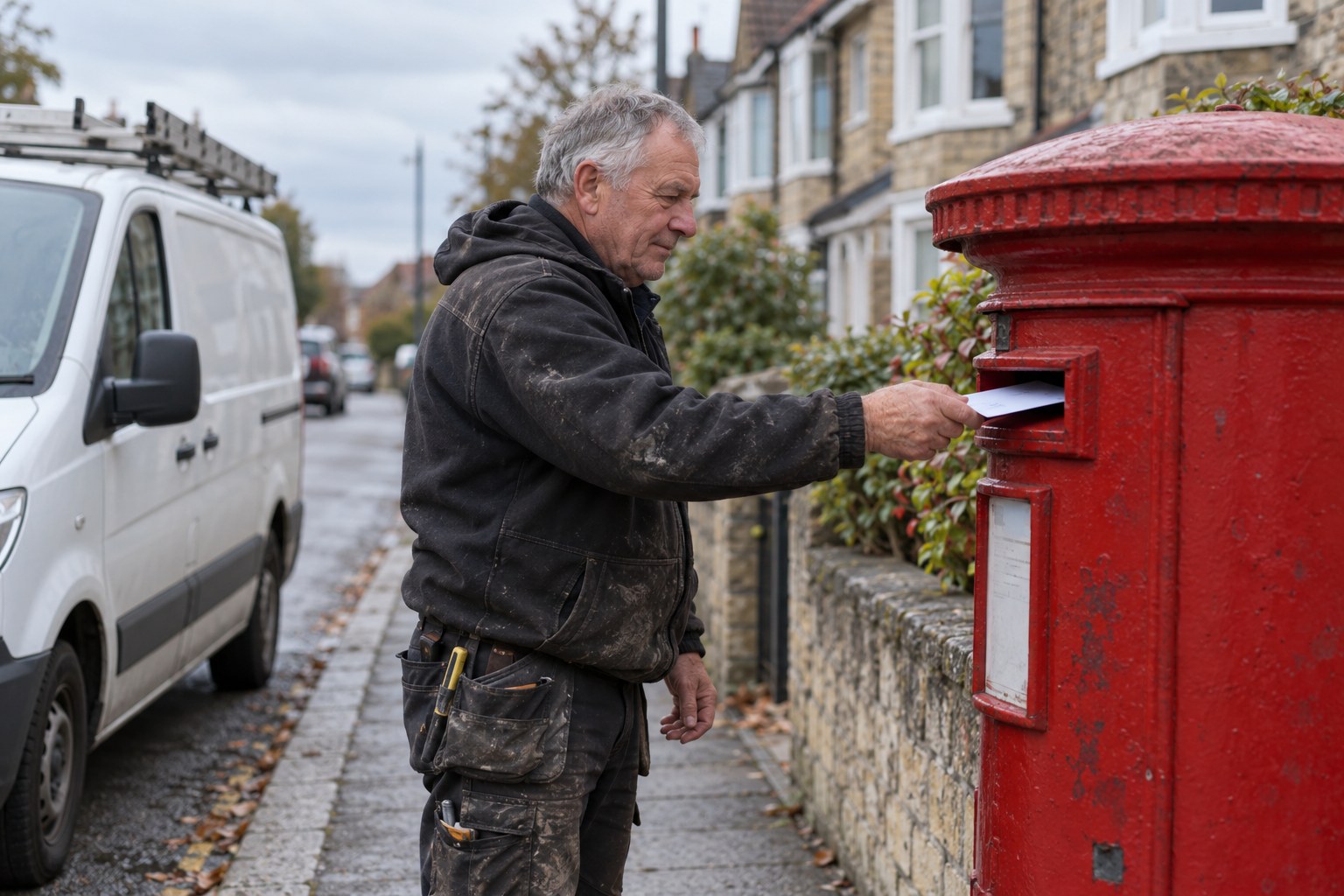
Letter before action template for a business customer
For a limited company or other business customer, the letter can be shorter, and the deadline is shorter too. You can also add statutory interest and compensation under the late payment law, unless your contract sets a different interest rate.
GOV.UK says the statutory interest on a late commercial payment is 8% plus the Bank of England base rate for business-to-business transactions, and that you can't claim it if your contract has a different rate. You can also claim a fixed sum for the cost of recovering the debt: £40 for a debt under £1,000, £70 for £1,000 to £9,999.99, and £100 for £10,000 or more.
Send it to the person who placed the order and to the company's accounts address, and keep the order number in the subject line. A letter that only reaches a site manager can sit unanswered while the deadline runs.
Dates, deadlines and how to send the letter
The date at the top of a letter of claim starts the clock, so the protocol says to post the letter the same day, or the next day if that isn't possible. If you date a letter on Monday and post it on Friday, the customer has lost four of their 30 days, and that can be held against you.
The protocol says the letter of claim should be sent by post. You can also email it if you have the customer's email address, and if the customer has asked you not to use post and given other contact details, use those. In practice, post it and email a copy the same day, saying "a copy of the letter posted to you today". A certificate of posting from the Post Office settles any argument about when it was sent.
Count the 30 days from the date at the top of the letter. If the customer doesn't reply within that time, the protocol says you may start a court claim. Put the deadline in your diary on the day you post it, not when you remember.
For a business customer, the Practice Direction says the reply time should be reasonable: 14 days in a straightforward case. An unpaid invoice with an order number and a signed-off job is about as straightforward as it gets.
Replies: instalments, disputes and debt advice
Most letters of claim get a reply, and the reply decides what happens next.
They pay. Thank them in writing, confirm the balance is cleared, and close the invoice.
They offer instalments. Look at the Financial Statement and decide whether the offer is realistic. The protocol asks creditors to have regard, where appropriate, to the Standard Financial Statement when agreeing instalments. A realistic plan that clears the debt in a few months is usually better than a court claim that ends with the same plan, plus fees and delay. Confirm the plan in writing, with the amounts and dates.
They're getting debt advice. The protocol says you must allow a reasonable period for that advice. It also says you shouldn't start court proceedings less than 30 days after you receive the completed Reply Form, or 30 days after you send any documents they've asked for, whichever is later. If the advice can't reasonably be obtained in 30 days, you're expected to allow extra time.
They dispute the invoice. Treat it as a complaint first. The protocol asks both sides to exchange the documents and information that matter, and to try to settle without going to court. If the customer asks for a document, the protocol gives you 30 days to provide it or explain why you can't. Your quote, job sheet, photos and any agreed variations are what settle most disputes. Our variation form template for trade jobs shows how to record extra work so it can't be argued about at this stage.

If you've had a reply but no agreement, the protocol says you should give at least 14 days' notice that you intend to start court proceedings, unless something urgent makes that impossible. Send that as a short letter, and keep a copy.
Mistakes that weaken a letter before action
The Practice Direction says the court takes non-compliance into account when it makes orders for costs. If a claimant didn't follow the rules, the court can order them to pay the costs of the proceedings, or reduce the interest they're awarded. Most of these mistakes are easy to avoid.
| Mistake | Why it matters | Do this instead |
|---|---|---|
| Giving a homeowner 7 days | The debt protocol expects 30 days from the date on the letter | Give 30 days, counted from the date at the top |
| Leaving out the Reply Form and Financial Statement | The protocol says they should be enclosed | Print them from the protocol's annexes |
| Dating the letter and posting it days later | The 30 days run from the date at the top | Post it the day you date it, or the next day |
| Adding fees the customer never agreed to | You can only claim what's owed, plus interest and charges you're entitled to | Claim the invoice, and say what interest you'll ask the court for |
| A letter styled like a court document | Falsely presenting a letter as official is an offence for business debts in England and Wales | Use your normal letterhead and plain words |
| Starting a claim while the customer gets advice | The protocol expects you to allow reasonable time | Wait at least 30 days after the Reply Form arrives |
On that fifth row: section 40 of the Administration of Justice Act 1970 makes it an offence, when chasing a contract debt, to falsely claim that criminal proceedings follow non-payment, to claim official authority you don't have, or to send a document falsely made to look official. For homeowners, consumer protection law covers the same ground. A letter on your own letterhead that says "we may start a court claim" is fine. A letter headed "County Court Notice" is not.
Example: an unpaid boiler repair
This is an invented example, following the same boiler repair as the reminders in the payment reminder guide. The names, dates and prices are made up.
Illustrative example: an unpaid boiler repair
Business: Brook Heating, a sole trader heating engineer
Customer: Mrs Doyle, homeowner
Debt: invoice 4051, £640, boiler repair on 3 October, due 17 October
Earlier steps: reminders on 18 October and 31 October; call on 25 October; final reminder giving 23 November to pay
Letter of claim: dated 24 November, sent by post and email that day; statement of account, Information Sheet, Reply Form and Financial Statement enclosed; proof of posting kept
Reply due: within 30 days of 24 November
Reply received: Reply Form returned on 5 December; Mrs Doyle accepts the debt and offers £80 a month
Outcome: plan agreed in writing on 6 December, eight payments of £80 from 15 December; invoice record notes each payment as it arrives
Sam, who runs Brook Heating, was tempted to go straight to a court claim when the final reminder ran out. That would have skipped the protocol, cost a court fee, and probably ended in an instalment plan much like the one Mrs Doyle offered herself. The letter of claim got that result in under two weeks, at the cost of a stamp.
If Mrs Doyle hadn't replied by the end of the 30 days, Sam's next step would have been a court claim. Because he'd followed the protocol, he could start one without worrying that the court would hold his conduct against him.
If the deadline passes with no reply
When the deadline passes with no reply and no payment, decide whether a court claim is worth it. Weigh the amount owed against the court fee, your time and the chance of collecting. In England and Wales, you can make a claim online or by post, and the fee depends on the amount you claim, including interest.
For a homeowner debt, GOV.UK says the interest rate for most debts that aren't owed by another business is usually 8%. Work it out as a yearly figure, divide by 365, and multiply by the number of days the debt has been overdue. For a business debt, use the statutory interest you claimed in the letter.
The court claim, the fees, mediation for disputed claims, statutory demands and the Small Business Commissioner for disputes with larger business customers are all covered in the Getting paid guide. If the customer has a dispute about the quality of the work, or the debt is large, take advice before you issue a claim.
This is not legal advice. It summarises the Ministry of Justice pre-action rules, GOV.UK guidance and legislation linked here, which apply in England and Wales. Scotland and Northern Ireland have separate court processes. If you're unsure which rules apply to your debt, take advice before you rely on them.
Send the letter for your oldest unpaid invoice
Find the oldest invoice where your final reminder has already run out. Decide which letter fits the customer, fill it in, print the enclosures if it's a homeowner, and post it the same day you date it. Put the reply deadline in your diary before the envelope goes in the postbox.
Check your invoicing app, then go back over your reminders

Free tool
Trade business software checklist: know what you need before you book a demo
List what an invoicing app has to do with reminders, statements and overdue lists before you rely on it.

Read next
Payment reminder messages: what to send when a trade invoice goes overdue
The three reminders that come before this letter, and the lines to leave out of every one.
Sources checked for this guide
Letter of claim, pre-action and interest points checked against the Ministry of Justice pre-action rules, GOV.UK and legislation.gov.uk. These are the primary sources used in this guide.
- Ministry of Justice, Pre-Action Protocol for Debt Claims
- Ministry of Justice, Practice Direction: Pre-Action Conduct and Protocols
- GOV.UK, Make a court claim for money: work out the interest
- GOV.UK, Late commercial payments: interest on late commercial payments
- legislation.gov.uk, Administration of Justice Act 1970, section 40