

On this page
If you want to stop missing calls while you are on a job, a new phone system is rarely the first fix. Most lost enquiries in a small trade business go missing after the phone stops ringing: a voicemail left unplayed until Friday, a WhatsApp from a landlord that sits under forty family messages, a web form that lands in an inbox the van can't see. This guide is for owner-run firms where the person answering the phone is often the person with their arm inside a boiler, up a ladder or halfway through a first fix. It covers how to catch every enquiry across phone, voicemail, text, WhatsApp and web forms, what to write down, who calls back and how fast, how to hand a booking over, and the UK data protection basics for recording calls and keeping customer details.
Plumbing and heating examples come up most, but the routine works the same for electricians, builders, roofers, joiners and property maintenance firms. Nothing here needs software you don't already have.
Find out where your enquiries are being lost before you change anything
Search for advice on missed calls and you will find plenty of alarming figures about how many calls tradespeople miss and what it costs them. Most of those numbers come from companies selling answering services or text-back tools, and you can't check how they were worked out. Your own numbers are more useful and take two weeks to collect.
For a fortnight, write down every enquiry that wasn't dealt with on first contact. Note the time, the channel it came in on, whether it was a new customer or an existing job, and what happened in the end. Then sort them:
- New work you didn't get back to in time. These are the ones that cost money.
- Existing customers chasing a job, a quote or an arrival time. Missing these doesn't lose a new job, but it does lose goodwill and generates more calls.
- Duplicates. The same person who rang, texted and filled in the form inside ten minutes is one enquiry, not three.
- Sales calls, wrong numbers and work you don't do. Leave these out of the count entirely.
Most firms find a pattern quickly. It might be the 8am to 9am window when everyone is driving, Saturday mornings, or the web form that goes unchecked. Fix the pattern you can see rather than the one a supplier's survey describes. If you want to turn your own figures into a rough value, the missed call calculator lets you put in low, base and high booking rates and shows what those calls could be worth as bookings.
Give every enquiry channel a named person who checks it
A missed call only costs you work if it isn't followed up, and the usual reason it isn't is that everyone assumed someone else would do it. Write down every way a customer can reach you, and next to each one put a name, a backup and when it gets checked.
| Channel | What tends to go wrong | Who checks it and when |
|---|---|---|
| Main business number | Rings out while you're on a job; diverts to a mobile that is in the van | Office person in office hours; owner at set breaks; backup named for holidays |
| Voicemail | Messages pile up unplayed; the greeting promises a callback that never comes | Same person as the phone, at fixed times, not "when I get a minute" |
| Texts and WhatsApp | Sit on one person's personal phone, mixed with family chats | Whoever owns the business number or business WhatsApp account |
| Website form and email | Go to an inbox that isn't opened on site | Office person morning and early afternoon; forward to a shared inbox |
| Messages from directory or lead sites | Arrive in a separate app with its own notifications | Named person, checked at the same times as email |
Phone and diverted calls need one rule about where they ring
Decide where the business number rings at each time of day and stick to it. If it diverts to the owner's mobile in the morning and the office landline after 10am, everyone needs to know that, including the office person who starts at half nine. When the call can't be answered, it should go to a voicemail that gets checked, not to a dead end.
Texts and WhatsApp messages belong on a business account, not a personal phone
Customers love sending photos of a dripping valve or a cracked tile on WhatsApp, and it is often the quickest way to work out what a job needs. The problem is when those messages live only on one engineer's personal phone. If he is off sick, on holiday or leaves, the enquiries go with him. Use a business account on a business phone where you can, and copy the details into your enquiry record rather than treating the chat as the record.
Web forms should ask for just enough to call back
A form that asks for name, phone number, postcode and a short description is enough to get started. Long forms with dropdowns for boiler make and model put people off and you will need to ask on the phone anyway. Make sure the form sends to an inbox that more than one person can see.
Write down the same short enquiry record every time so anyone can make the callback
The test of a good enquiry record is simple: could someone who wasn't there pick it up and ring the customer back without sounding lost? Write the same short set of details for every enquiry, whether it came by phone, voicemail, text, WhatsApp or the website, and keep them in one shared place that everyone checks. Our enquiry form template for trade businesses gives you the ten fields to copy onto a pad, a spreadsheet or a website form, with extra questions for each trade.
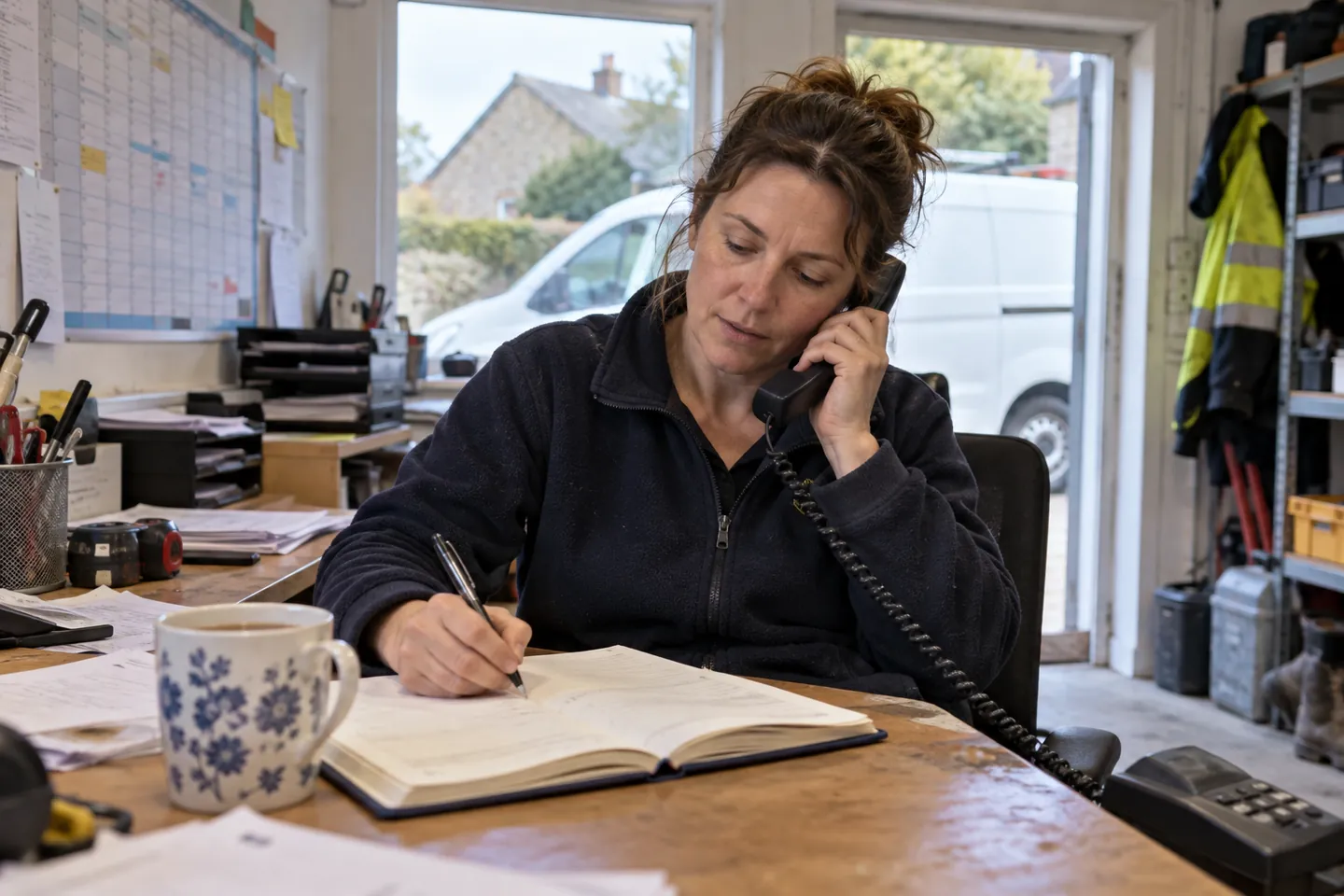
Make one person responsible for each callback, and name who covers when they can't
"We'll call you back" is a promise from the business, but somebody has to keep it. Every enquiry in your record should have one name against it, not "office" or "the lads". In a two-person business that might be simple: the office person owns every callback in office hours, and the owner owns anything before 9am and after 5pm. In a firm with a few engineers you might split by work type, so the electrician owns electrical enquiries and the office person owns everything else.
Ownership needs a backup rule. If the callback is due and the owner hasn't made it, who takes it over? Write it down: "If a callback is more than an hour overdue, the office takes it", or "If Dave is on a roof all day, the enquiry goes to Sarah". Then change the name on the record so it's clear who has it now. When an enquiry changes hands, the new owner should be able to see every previous attempt so the customer isn't asked the same questions twice.
Set callback times by type of enquiry, and only promise what you can keep
Not every enquiry needs a call back in ten minutes, and promising that to everyone sets you up to fail. Sort enquiries into a few types and set a target for each that your actual cover can meet. These are examples to adapt, not industry standards:
| Type of enquiry | Trade examples | Example callback target |
|---|---|---|
| Urgent and possibly unsafe | Water coming through a ceiling, no power to the whole house, a roof open in the rain | As soon as anyone can safely stop; a short text straight away if not |
| Urgent but not dangerous | No heating or hot water, a blocked only toilet, a door that won't lock | Within an hour or two, and the same morning or afternoon at worst |
| New quote or estimate request | Bathroom refit, consumer unit upgrade, loft conversion, fencing | Same working day |
| Existing customer question | "What time are you coming?", "Did you get my photos?", invoice queries | Same working day, sooner if they are expecting someone that day |
Two rules make this work. First, the person taking the message should not try to diagnose or price the job; their job is to capture it accurately and set the right type. Second, if you can't make a proper call by the target, send a short text so the customer knows they haven't been forgotten. "Thanks for your message about the bathroom. I'm on a job until 4pm and will ring you after that" keeps most people from ringing the next firm on the list.
If the caller mentions a smell of gas or suspected carbon monoxide, the first step is not your callback. Tell them to ring the National Gas Emergency Service on 0800 111 999, which is free and open 24 hours a day.
Use a few plain statuses so you can see which enquiries are stuck
Statuses tell you what needs to happen next without reading every note. Keep the list short enough that everyone uses it the same way.
| Status | What it means | What happens next |
|---|---|---|
| New | Received but not yet looked at properly | Give it an owner, a type and a callback time |
| Callback due | Someone owns it and has a time to ring | The owner calls, or the backup takes over if it goes overdue |
| Waiting on customer | You've tried or asked for something (photos, a date, access details) | Set a date to try again; this is not closed |
| Ready to book | You've spoken and the customer wants a visit or the work | Check diary and engineer before offering a slot |
| Booked | Date and time agreed and confirmed with the customer | Create or link the job record and send a confirmation |
| Closed, not booked | Finished without a booking | Record the real reason: duplicate, not our work, customer went elsewhere, no reply after agreed attempts |
The "Closed, not booked" reasons are where you learn the most. If a lot say "went elsewhere" and the callback was late, speed is the problem. If a lot say "not our work", your website or directory listing may be bringing in the wrong enquiries.
Make the callback count: what to say, what to ask and what to promise
A good callback is short and leaves the customer sure about what happens next. A simple order that works for most trades:
- Say who you are and why you're ringing: "Hi, it's Jo from Smith Plumbing, returning your call about the leak under the sink."
- Check the address and whether this is a new problem or about a job you've already done.
- Ask the questions you need to decide the next step, such as whether the water is turned off, how old the boiler is, or whether they can send a photo of the fuse board.
- Say what happens next and when. Only offer a date or price if you are the person who can commit to it.
- Agree how you'll confirm: text, email or WhatsApp.
Then update the record before you do anything else. A callback that isn't written down is the next missed enquiry.
When the customer doesn't pick up
Agree a sensible number of attempts and stick to it. A common approach is to ring, leave a short voicemail, send a text with your number, and try once more the next working day. After that, close the enquiry with "no reply after agreed attempts" rather than leaving it open forever. Record what you did, not what you assume happened.
Hand over a booked enquiry with everything the engineer needs on the day
"Booked" should mean the person turning up has what they need, not just that a slot is in the diary. Before you mark an enquiry as booked, check:

- The right customer name, phone number and job address, including any access details (key safe, tenant's number, parking).
- A clear summary of the problem and any photos the customer sent, attached to the job rather than left in a chat.
- That the engineer going has the right skills and the time; a gas job needs a Gas Safe registered engineer, and a consumer unit change needs an electrician competent to do and certify the work.
- The arrival window and anything agreed about cost, such as a call-out charge or a quote visit being free, given by someone allowed to agree it.
- How the booking will be confirmed, and the enquiry linked to the new job reference.
- Any open questions with a name next to them, rather than buried in a note.
If the enquiry is for a quote visit, the details you capture here are the starting point for the price. The guide to writing and following up trade quotes picks up from this stage.
Close out the day in ten minutes so no enquiry carries over unseen

The habit that does most to stop missing calls turning into lost jobs is a short review before you finish for the day. Before the office shuts or the owner puts the phone down for the evening, look at the enquiry record and check four things:
- Any enquiry without an owner.
- Any callback that is overdue.
- Anything "Waiting on customer" with no next date.
- Any "Booked" job missing an address, contact number or confirmation.
Also play the voicemail one last time and check the form inbox and WhatsApp. Anything that came in late gets a record and an owner for the morning. The owner-manager doesn't need a long report, just the exceptions. The printable call handling checklist sets this out as a checklist you can stick on the office wall or keep in the van.
Once a week, count new enquiries (leaving out duplicates, sales calls and wrong numbers), how many you spoke to, and how many booked. Compare one week with the next and note anything unusual, such as someone on holiday or a spell of cold weather. These are your own figures for your own business, not a benchmark to compare against other firms.
Set up voicemail and missed-call texts so callers know exactly what happens next
A voicemail greeting should tell callers they've reached the right business, what to leave and when they'll hear back, in under twenty seconds, and give the gas emergency number first if you do gas work. Only promise a callback time your close-out routine keeps. Our voicemail messages for tradespeople give you greetings to copy for working hours, evenings, weekends and holidays, with a missed-call text to match.

Missed-call text replies are fine if they stick to the facts
Many phone systems and apps can send an automatic text when you miss a call. A factual message such as "Sorry we missed you. We're on a job and will call back by 5pm. Reply with your postcode and the problem if that's easier" is helpful. Be careful about adding offers. The ICO says a service message, such as an appointment reminder, is not direct marketing, but if it includes something promotional it counts as marketing and the marketing rules apply. Keep automatic replies to information only.
Tell out-of-hours callers exactly what you cover and what you don't
Out-of-hours calls are where small firms most often over-promise. Decide what you offer and say so in your voicemail, on your website and in your missed-call text:
- No out-of-hours service. Say when you'll call back ("next working morning") and, where it matters, where to go for emergencies.
- Emergencies only. Define what counts. "Water you can't stop, total loss of power, no heating for vulnerable people" is clearer than "emergencies".
- An on-call rota. Name who is on call each night or weekend, and what happens if they don't answer.
Out-of-hours enquiries that aren't urgent go into the same enquiry record with an owner and a callback time for the next working day. Saturday's voicemail about a bathroom quote should not still be sitting there on Wednesday. If you offer emergency call-outs, agree your prices in advance and say them on the call, because a disputed out-of-hours bill is one of the harder conversations in any trade.
Recording calls and keeping customer details: the UK data protection basics
Every enquiry record is personal data, so UK data protection law applies even to a sole trader with a notebook. This section summarises official guidance; it is not legal advice, and the ICO notes that some of its guidance is under review following the Data (Use and Access) Act.
Tell people if you record calls
Recording calls can help settle what was agreed, such as a price or an arrival time. If you record, tell callers before the conversation, usually with a short message at the start of the call. The business interception rules (the Investigatory Powers (Interception by Businesses etc. for Monitoring and Record-keeping Purposes) Regulations 2018) allow a business to record calls for purposes such as establishing facts, but only if it has made all reasonable efforts to tell people using the system that calls may be recorded. Separately, the ICO says people have the right to be told how their personal data is used, including your purposes, how long you keep it and who you share it with, at the time you collect it.
Keep only what you need, for only as long as you need it
The ICO says you must not keep personal data for longer than you need it, you should be able to justify how long you keep it, and you should review and delete what you no longer need. For an enquiry that never became a job, ask yourself why you would still need the customer's number in two years. Decide your own retention periods for enquiries, recordings and job records, and get advice if you're unsure; this guide doesn't set them for you.
Callbacks are not marketing, but adding customers to a sales list is
Ringing someone back because they asked you to is part of dealing with their enquiry. Using their number later to sell a boiler service plan is marketing. The ICO says live marketing calls must not go to numbers on the Telephone Preference Service unless the person has specifically agreed to your calls, even if they're an existing customer. Keep the two uses separate.
Check whether you need to pay the data protection fee
The ICO says organisations, including sole traders, that use personal information need to pay a data protection fee unless they are exempt. Check the ICO's fee page to see whether an exemption applies to you.
When an answering service, AI receptionist or text-back tool is worth paying for
Once the routine above is running for a few weeks, you'll know whether your problem is the process or the cover. If calls are still going unanswered in the same windows, when everyone is busy on jobs, paying for help may make sense. If calls are answered but enquiries still go cold, a new service won't fix that, because someone still has to own the callback.
The options are a human answering service, an automated or AI receptionist, or a missed-call text reply. Each one can take a message; the question is whether it hands the enquiry over in a way that fits the record, owner and status routine you've just set up. The comparison of call-handling options for trade businesses sets out what to check with each. Use your fortnight of notes and the missed call calculator to work out whether the monthly cost is likely to be covered by the work you're currently losing.
Guides in this section
Shorter guides that go deeper on calls and enquiries.

Voicemail message for tradespeople: what to say when you can't pick up
Three greetings to record, for working hours, evenings and weekends, and holidays, a missed-call text to match, the safety line to put first, and how to clear the messages.

Enquiry form template for trade businesses: what to record on every call, text and web form
Ten fields to copy onto a pad, a spreadsheet or a website form, extra questions for each trade, a filled-in example, and what to tell people when you take their details.
Use the free calculator and checklist, and compare paid call handling options

Free tool
Missed call calculator: see what unanswered enquiries could be worth to your trade business
Put in your missed calls, average job value and booking rate to see what those calls could be worth. An illustration from your own figures, not a forecast.
Open the calculator

Free tool
Call handling checklist: a printable daily routine so every trade enquiry gets a callback
The daily close-out from this guide as a one-page checklist for the office wall or the van.
Get the printable checklist

Read next
Call answering service, AI receptionist or missed-call text: which suits a UK trade business?
Compares answering services, AI receptionists, text-back and diversion: how each is charged, what to ask, and a test to run before you sign up.
Read the comparison
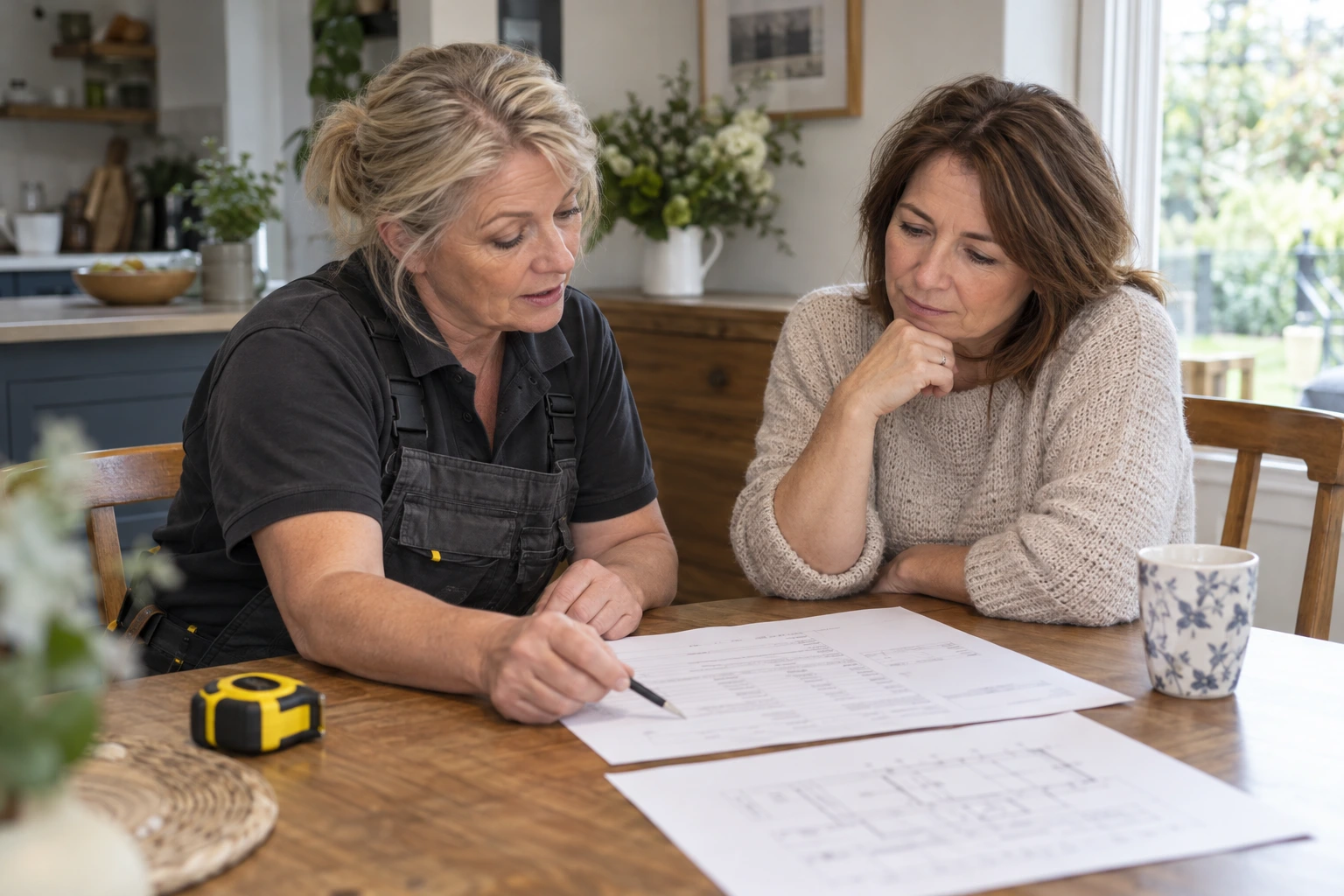
How to write a quote for trade work and follow it up so more customers say yes
Picks up where a booked quote visit leaves off: what to put in the quote and how to follow it up.
Read the quotes guide
Sources checked for this guide
Call recording and data protection points checked against ICO guidance and UK legislation.
- ICO, Principle (c): Data minimisation
- ICO, Principle (e): Storage limitation
- ICO, Right to be informed
- ICO, Marketing and data protection in detail (service messages)
- ICO, Telephone marketing
- ICO, Data protection fee
- legislation.gov.uk, Investigatory Powers (Interception by Businesses etc.) Regulations 2018, regulation 3 and regulation 4
- National Gas, Emergency contacts
- HSE, Domestic gas: frequently asked questions