

On this page
The first decision with a voicemail message for tradespeople is when you'll call back, because that promise is what the caller remembers. Pick a callback time your working day can keep, such as by 5pm or within two hours, and build the greeting around it. A greeting that promises a quick callback and then misses it loses more work than one that promises a slower callback and keeps it.
Below are three greetings to record, for working hours, evenings and weekends, and holidays, plus a missed-call text to send with them. Each one is short, gives the safety line first where it matters, and tells the caller exactly what to leave. For the wider routine of answering, logging and returning every enquiry, see the guide to stopping missed calls on the job.
Decide your callback promise first
Most tradespeople record a greeting once, years ago, and never think about it again. It usually says something like "leave a message and we'll get back to you", which tells the caller nothing about when. A caller with water coming through the ceiling hears that and rings the next firm on the list.
A callback promise works when it matches how your day runs. If you're on the tools from 8am and check messages at lunch and again after the last job, "by 5pm today" is a promise you can keep for anything left before 3pm. If there's a partner or office person who listens to messages every couple of hours, "within two hours" might work during their hours and nowhere else. If you can only return calls in the evening, say so: "we'll ring you back this evening" is better than an open-ended "soon".
Write the promise down before you record anything, and check it against a normal week. If you'd have missed it on two days out of five, make it later. A later promise that's kept every time builds more trust than a fast one that's kept now and then.
The promise also changes by time of day. A call at 10am on a Tuesday and a call at 8pm on a Saturday need different answers, which is why this guide gives you more than one greeting. Change the greeting when your situation changes, not once a year.
Four parts of every voicemail greeting
Every greeting below has the same four parts, in the same order. Keep the whole thing under twenty seconds, because callers stop listening after that and start talking over the end of it.

The first part is the business name, so the caller knows they've reached the right firm. Customers often ring three or four numbers from a search, and a greeting that only says "leave a message after the tone" leaves them guessing which one they've reached.
The second part is the safety line, for trades where a caller might be in danger. For anyone who works on gas appliances, that's the gas emergency number, placed before anything else so a caller who smells gas hears it first. The safety line section below covers the wording.
The third part is what to leave. Ask for the four things you need to call back properly: their name, their number, the address or postcode, and a few words about the problem. Callers who are told what to leave give you fuller messages, and you spend less time ringing back to ask.
The fourth part is the callback promise, in plain words. "We'll call you back by 5pm today" or "we'll ring you back on Monday morning" tells the caller what happens next and gives them a reason not to ring someone else.
Voicemail greetings to copy for working hours
This is the greeting most callers will hear: you're working, the phone rings and you can't get to it. Record it on whichever line customers ring, whether that's a mobile, a landline or a business number that diverts to your mobile. Fill in the square brackets before you record, and read it through twice so it sounds like you talking, not reading.
If you don't do gas work, you can replace the gas line with "If anyone is in danger, hang up and call 999." Some trades leave the safety line out altogether, but a roofer or a builder still gets the odd call from a customer who has found something dangerous, and the line costs you three seconds.
For a business in Northern Ireland, use 0800 002 001 in the gas line instead. The safety line section explains why the numbers differ.
Greetings for evenings, weekends and holidays
Out-of-hours callers need to know three things the working-hours greeting doesn't tell them: that you're closed, when you'll be back, and whether you take emergency calls. Most small firms get this wrong by keeping the working-hours greeting on all weekend, so Saturday's callers hear "we'll call you back today" and wait for a call that comes on Monday.
Record this second greeting and switch to it at the end of each working day, or set your phone system to switch automatically if it can. The bracketed lines change for a holiday.
Pick one emergency line and delete the other. If you do offer emergency call-outs, say what counts, in the customer's words: "water you can't turn off" is clearer than "emergencies". If you don't, say so plainly, because a caller who knows you're closed will look elsewhere for help straight away instead of waiting on you.
For a holiday, the return date matters more than anything else in the greeting. "We're away until Sunday the 18th and we'll return calls from Monday" lets a customer with a small job decide to wait for you. Without a date, they assume the worst and book someone else.
Put the safety line before anything else
The safety line comes second, straight after the business name, for a reason. Someone who smells gas may ring the engineer who last serviced their boiler before they think of the emergency number. If the safety line comes after the instructions about what to leave, they may already have started talking.
The HSE says that if you suspect a gas leak, you should call the gas emergency freephone number, 0800 111 999, open doors and windows, and turn the gas off at the meter control valve if you know where it is. The same number is given for suspected carbon monoxide. In Northern Ireland, HSENI lists the NI Gas Emergency Service on 0800 002 001, available 24 hours.
Keep the line short. "If you smell gas, hang up and call the gas emergency number, 0800 111 999" is enough. Don't add advice about what else to do, because the emergency service will give that on the call, and a long safety line pushes the rest of the greeting past twenty seconds.
For trades that don't work on gas, the general line, "If anyone is in danger, hang up and call 999", covers a ceiling that looks ready to come down or a burning smell from a consumer unit. None of these lines involves telling the caller how to fix anything. The greeting points to help; the diagnosis waits for the callback or the visit.
Match the missed-call text to the greeting
Many phone systems and job apps can send an automatic text when you miss a call, and you can send the same text by hand from the van. A text reaches callers who hang up without leaving a message, which is most of them, and it gives them the same promise as the greeting.
Keep the text to information only. The ICO says a service message is for information only and can't contain anything promotional, such as a booking reminder. Add an offer, such as a discount on a boiler service, and the ICO treats the message as direct marketing, so the marketing rules apply. The ICO notes that this guidance is under review following the Data (Use and Access) Act. Our quote follow-up messages for trades explain the marketing rules in more detail, for when a message to a customer goes beyond the job in hand.
This is not legal advice. It summarises ICO guidance, which applies across the UK.
Use the same callback time in the text as in the greeting. A caller who hears "by 5pm" on the voicemail and reads "tomorrow morning" in the text will trust neither.
Record it so callers hear every word
A greeting that's hard to hear is almost as bad as no greeting. Most are recorded on the job, with a radio, a van engine or a drill in the background, and callers lose the words that matter.
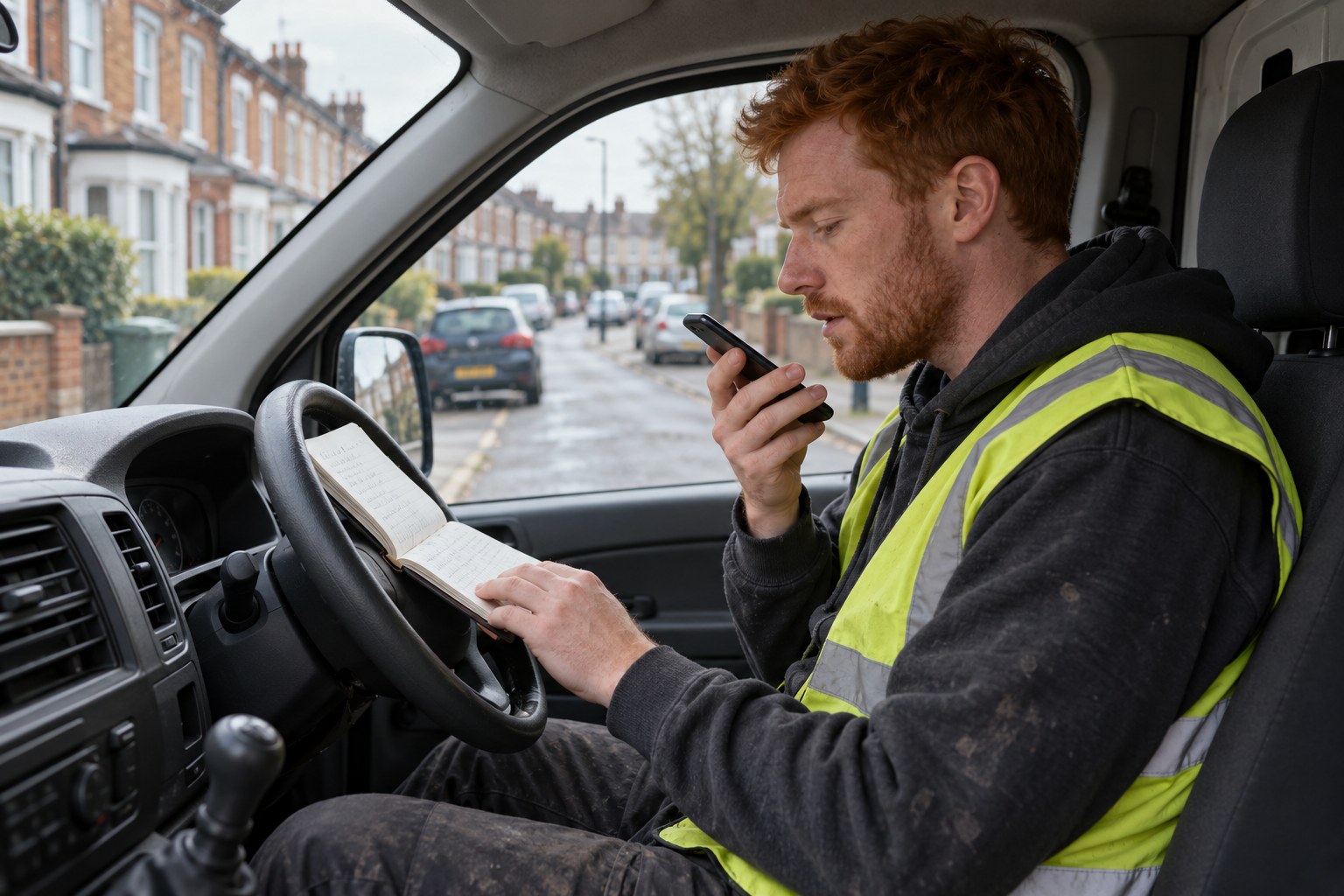
Record it somewhere quiet: a parked van with the windows up, a spare room or the office after everyone has gone. Write the words down first and read them, but read them as if you're talking to one customer. Slow down on the phone numbers, and say each one in the groups people write them in.
Then ring your own number from another phone and listen to it the way a customer would. Check that the business name is clear, the safety number can be written down at the speed you said it, and the whole thing finishes inside twenty seconds. If it runs long, cut words from the third part, not the safety line or the callback promise.
If there's a partner or office person, it doesn't matter which of you records it, as long as the voice is clear and the greeting says "we". A greeting in the owner's voice that says "I'll call you back" sets up a problem on the days someone else makes the callbacks.
Clear the voicemail into your enquiry record
A voicemail isn't dealt with until it's written down somewhere that whoever makes the callback will see it. Play each message, write it onto your enquiry record, then delete it from the phone. Messages that stay on the phone get forgotten, and the next person to check hears a list of old ones and gives up halfway through.
Our enquiry form template for trade businesses gives you the fields to write each message onto, so a voicemail, a text and a web form all end up in the same place. If the greeting asked callers for their name, number, postcode and problem, most messages fill the form in one go.
Fix the times the voicemail gets cleared, and put them in the call handling checklist on the office wall: first thing, lunchtime and the end of the day is a common pattern. The callback promise in your greeting only works if those times happen.
Deleting messages once they're logged also keeps you on the right side of data protection. A voicemail holds personal information: a name, a number, an address and often details about the customer's home. The ICO says you must not keep personal data for longer than you need it, and that you should review what you hold and erase it when you no longer need it. Once the details are in your enquiry record, the recording has done its job.
Example: a week of greetings
This is an invented example to show the greetings in use. The business, names and times are made up.
Illustrative example: a week of greetings for a two-person electrical firm
Business: Kerr Electrical, an electrician who works on site and a partner who does the office on Monday, Wednesday and Friday mornings
Weekdays, 8am to 5pm: working-hours greeting, with the safety line for 999, promising a callback by 5pm for messages left before 3pm
Office mornings: the partner clears voicemail at 9am and 11.30am and writes each message onto the enquiry form
Other times: the electrician clears it at lunch and at 4.30pm, from the van
Evenings and weekends: out-of-hours greeting, back at work at 8am the next working day, no emergency call-out
Holiday week: away greeting with the return date; missed-call text changed to say calls are returned from Monday
Missed-call text: the same callback time as the greeting, with no offers
Before the change, the greeting said "leave a message and we'll get back to you" all week, including the fortnight the firm was closed in August. Messages were often just a name and "call me", so each callback started with a list of questions. With the new greetings, most messages included a postcode and the problem, and Saturday callers knew to expect a call on Monday instead of chasing on Sunday.
Check voicemail and diverts on a digital landline
If your business number is a landline, it's likely to move onto a digital line soon. Ofcom says BT plans to retire its old landline network by 31 January 2027, and that you can keep your phone number. Other networks plan to retire theirs too, on dates not yet set.
Ofcom also says digital landlines need mains electricity and won't work in a power cut unless there's a battery back-up. A power cut at the office could mean the line doesn't ring and the greeting isn't played, so if the landline is your main business number, ask your provider what happens to calls and voicemail when the power goes off.
When your line is switched, ring your own number from a mobile and check the greeting still plays, any divert to your mobile still works, and messages still reach you. Settings don't always carry over, and you won't find out from callers, because they'll just ring someone else.
Greeting mistakes that send callers elsewhere
A promise the routine doesn't keep. "We'll call you back within the hour" sounds good, but if the callbacks happen at lunch and after the last job, most callers are let down. Promise the time your clearing routine gives you.
The same greeting all weekend. A working-hours greeting on a Saturday tells callers they'll hear from you today. Switch to the out-of-hours greeting every evening, or set it to switch automatically.
No business name. The phone's default greeting, or "leave a message after the tone", leaves callers unsure whether they've reached the right firm.
A full mailbox. A caller who hears "this mailbox is full" can't leave a message at all. Clearing messages into the enquiry record and deleting them fixes this.
Offers in the missed-call text. A discount line turns a service message into marketing. Keep the text to the callback and what to send.
Record your new greeting before tomorrow's first job
Write your callback promise down, fill in the two greetings and the missed-call text, and record the working-hours greeting tonight somewhere quiet. Ring your own number from another phone to check it, then put the out-of-hours greeting on before you finish for the day.
Count the calls you miss, then compare the options

Free tool
Missed call calculator: see what unanswered enquiries could be worth to your trade business
Put in the calls you miss each week to see what those unanswered enquiries could be worth.

Read next
Call answering service, AI receptionist or missed-call text: which suits a UK trade business?
When a greeting and a text aren't enough, compare answering services, AI receptionists and text-back.
Sources checked for this guide
Gas emergency, service message, data retention and landline switchover points checked against HSE, HSENI, ICO and Ofcom guidance. These are the primary sources used in this guide.