

The common mistake when trades take card payments on site is adding a fee for paying by card. You can't charge a homeowner extra for paying with their debit or credit card, so the cost of taking cards has to go into your prices. Once that's settled, the choice is about which way of taking cards suits your work, what each one costs you, and keeping the records that protect you if a customer disputes a payment.
This guide is for plumbers, heating engineers, electricians, builders and other owner-run trade firms who want customers to pay on the day rather than wait for an invoice. It sits under our guide to getting paid for trade work.
Card surcharges are banned for home customers
Since 13 January 2018 the Consumer Rights (Payment Surcharges) Regulations 2012 have banned surcharges on consumer debit and credit cards and on similar ways of paying, such as PayPal. The government's guidance on the surcharge regulations says the ban covers the vast majority of cards people carry, including Visa and Mastercard.
So "plus 2% if you pay by card" on a quote or invoice for a homeowner is not allowed, however small the fee. You can still charge a booking fee or call-out charge, as long as it's the same however the customer pays.
Trading Standards make two points worth knowing. It's the type of card that decides it, not who the customer is, so a sole trader paying you with their personal card is covered by the ban. And a customer asked to pay a banned surcharge doesn't have to pay it, and can claim it back if they already have.
Business customers paying with a company card
The ban doesn't cover commercial cards, the company cards that businesses issue to staff. A business customer paying with one can be charged a fee, but the government guidance says it mustn't be more than the payment costs you to process.
In practice, few trade firms bother. Working out your real cost per card type is fiddly, a fee on a commercial card looks petty to a landlord or agent you want repeat work from, and you can't always tell a commercial card from a personal one at the door. Price business work the same way as home work and leave the card cost in the price.
Ways to take a card on a job
There are four common ways to take a card payment, and many trade firms use two: one for the doorstep and one for customers who aren't there when you finish.
| Way to pay | What you need | Best for | Watch for |
|---|---|---|---|
| Card reader | A small reader paired to your phone, and a provider account | Paying at the door when the job's done | Reader cost, signal at the property, battery |
| Tap to pay on your phone | A compatible phone and a provider app | Occasional card payments without carrying a reader | Not every phone or provider supports it |
| Payment link | A provider account; the link goes by text, email or on the invoice | Landlords, absent customers, deposits | Usually a higher fee than a reader |
| Bank transfer | Your bank details on the invoice | Large jobs and business customers | No card protection for the customer; invoice fraud |
A card reader or tap to pay suits jobs where the customer is in and the price was agreed up front. A payment link suits everything else: deposits, jobs where the tenant lets you in but the landlord pays, and customers who say "send me the bill". Most providers let you do both from one account.
No signal at the property
Card readers and tap to pay need a data connection to approve a payment, and plenty of trade jobs happen in cellars, plant rooms, rural cottages and new builds with no Wi-Fi yet. Find out what your provider's reader does without signal before it matters. Some readers can store a payment and send it when you're back online, but a card that's declined later may not show up until you've left, so ask your provider who carries the loss.
The simpler habit is to take the payment where there is signal: at the front door, on the drive or in the van. If there's no signal anywhere, send a payment link before you leave and wait while the customer pays on their own phone, or agree that they'll pay by bank transfer that evening and note it on the job sheet.
Fees to compare before you sign up
Card providers price in different ways, so compare the total you'd pay on a typical month of your own work, not the headline rate. The parts to ask about are:
- the percentage charged on each in-person payment
- the percentage, and any fixed amount, charged on payment links
- any monthly fee, and what it buys you
- the cost of the reader, and whether it's bought or rented
- the fee for a refund, and whether the original charge comes back
- any fee for a disputed payment, even one you win
- how quickly the money reaches your bank account
A low percentage with a monthly fee can cost more than a higher percentage with none if you only take a few card payments a month. Work it out with your real numbers.
Questions to ask a card provider
Before you sign up, ask the provider these, by email so you have the answers in writing:
- Can I take card payments in person and send payment links from the same account?
- How long do payments take to reach my bank account, and does that change for bigger payments?
- Will you ever hold back my money, and what would make you do that?
- What do you charge if a customer disputes a payment, and how do I send evidence?
- Can I export payments with the customer name and an invoice number, for my records and my accountant?
- Does it link to the job or accounts software I already use?
The question about holding money matters more than people expect. Some providers delay or hold payouts on large or unusual payments, such as a first big deposit. Ask what limits apply before you need them.
Put the card cost into your prices

Because you can't add a fee for home customers, the card cost is a running cost like fuel or insurance, and it belongs in your day rate and your prices. Our guide to working out your day rate shows where running costs fit in.
The calculation is simple. Multiply your average card cost by the share of your income that comes in by card. For example, if cards cost you about 1.75% and 70% of your income arrives by card, card costs take about 1.2% of everything you earn. On a £200 day rate, that's about £2.40 a day.
Most trade firms find the cost is smaller than the time they used to spend chasing unpaid invoices. That's the real reason to take cards: money on the day, not 30 days later.
Payment links and card details by phone
When a customer wants to pay by card but isn't with you, send a payment link from your provider. They type their own card details into the provider's secure page, and you never see the card number.
Don't take card numbers over the phone and write them down, whether on the enquiry record, a job sheet or a notebook in the van. Don't ask for them by text or WhatsApp either. If someone reads you their card number, stop them, and send a link instead.
Put the way to pay on every quote and booking message, so no customer is surprised at the end of the job. Here's wording you can copy:
Customers who pay after you leave
Some customers won't be in when you finish, and some will ask to pay later. Don't leave without agreeing how and when. Send the invoice with a payment link before you drive away, and put the due date on it. A link that arrives while the customer is looking at the finished job is easier to pay than an invoice that turns up a week later.
If the money hasn't arrived by the due date, follow your normal reminder routine. Card payments don't change your payment terms; they just make paying easier, so keep the terms on the quote and the invoice the same.
Engineers taking payments for you
If you employ engineers or use subcontractors, decide who takes the money before anyone does. Most providers let you add team members to one account, each with their own login, so every payment lands in the business account and shows who took it. Don't let an engineer take payments on a reader linked to their own account, even for a day.
Agree what an engineer can and can't do: take payment for the agreed price, yes; give a discount, change the price or refund a customer, no, without asking you first. Write it down, and check the payments against the job sheets at the end of each week.
Taking deposits by card
Card payments suit deposits well, because the customer pays from a link the day they accept, and you don't order materials until the money's in. Our guide to taking a deposit before starting work covers how much to ask for and the wording to use.
Homeowners are often told to pay by credit card for a reason. A credit card payment for something costing more than £100 and no more than £30,000 can give them a claim against the card provider if the work goes wrong, as well as against you. That isn't a reason to avoid credit cards. It's a reason to keep good records of every job, because the customer has an easy route to a refund if you can't show what you did.
If a customer disputes a card payment
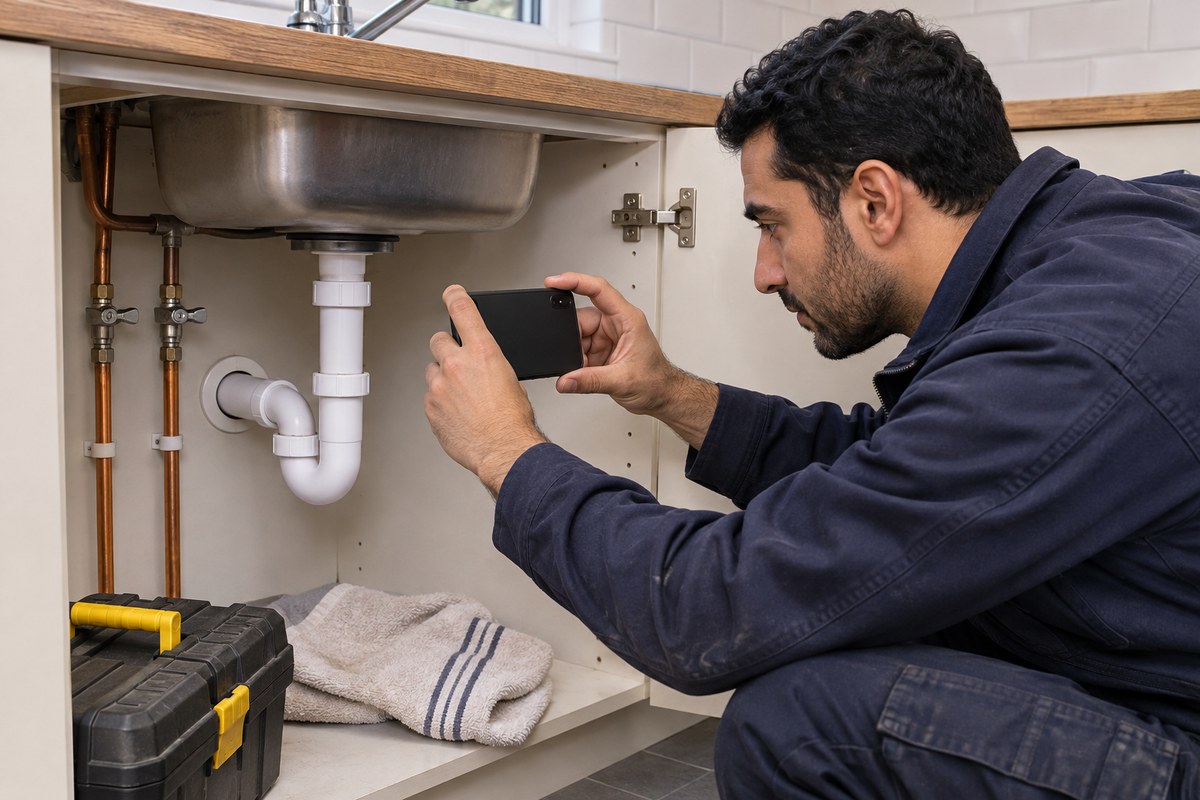
A customer unhappy with a job can ask their card provider for their money back instead of coming to you. Citizens Advice tells consumers to try the trader first, and then to use a section 75 claim for credit cards or a "chargeback" for debit cards. It also says the trader can challenge the refund, even after the customer has had the money back.
Your provider will tell you about a dispute and give you a short time to send evidence. What wins is the same paperwork that settles any argument about a job: the agreed quote, any signed changes, the job sheet, before and after photos, and the customer's sign-off. Our guide to photos to take on a job covers what to photograph and how to file it by job.
Reply to the provider by the date they give, with the evidence in one go. A dispute you don't answer is usually lost.
Refunds go back to the card
If you agree to refund a customer, refund the card they paid with, through your provider, rather than sending money to their bank or handing over cash. It keeps the record clean, and it means the refund matches the payment if there's ever a dispute.
For jobs the customer cancels within their cancellation period, the rules on how and when you refund are set out in our guide to cancellation rights for trade work, including refunding by the same method the customer used.
Record card takings and fees
Your provider pays you the card takings minus its fees, often in one payment covering several jobs. Don't record that lump sum as your income. Record each job's full amount as income against its invoice, and record the fees separately.
GOV.UK lists bank, overdraft and credit card charges among the financial costs a self-employed person can claim as business expenses. Card processing fees are a cost of taking payment, so download your provider's monthly statement, keep it with your accounts and ask your accountant how to record the fees.
Match each card payment to its invoice the same day. Our invoice template for trades shows where to put your payment details, including the payment link.
You choose which payments you accept
You don't have to accept cash, or cards, or any particular way of paying. The Bank of England explains that legal tender has a narrow meaning about settling debts, and that a business can choose what to accept. Payment is a matter of agreement between you and the customer.
So say which methods you take before you start, on the quote and in the booking message, and stick to them. If you'd rather not carry cash, say "card or bank transfer only". If a customer can only pay cash, agree it before the job and give a receipt.
This is not legal advice or tax advice. It summarises GOV.UK, Trading Standards, Citizens Advice and Bank of England guidance. The surcharge rules apply across the UK; Citizens Advice's guidance is written for England and Wales, and the legal tender rules differ between England and Wales, Scotland and Northern Ireland.
Illustrative example: a plumber's month of card payments
This is an invented example to show the sums. The plumber, customers and fees are made up, and your provider's fees will differ.
Illustrative example: a month of card payments for a sole-trader plumber
Takings: £6,000 by card in the month, from 22 jobs. £5,100 at the door on a reader, £900 by payment link (two landlord jobs).
Reader fees: £5,100 at an assumed 1.75% = £89.25.
Payment link fees: £900 at an assumed 2.5% = £22.50.
Monthly fee: none. Total card cost: £111.75, about 1.9% of card takings.
Bank transfers: £2,400 from two larger jobs, no card cost.
Card cost across all £8,400 of income: about 1.3%.
Dispute: one £240 repair questioned by the customer's bank. The plumber sent the quote, before and after photos and the signed job sheet within the deadline, and kept the money.
The plumber added 1.5% to his prices at his yearly review, which covers the card cost with a small margin. In the same month he chased only one unpaid invoice.
Ask two providers for their fee lists
Pick two card providers that suit the way you work, and email each one the questions above. Compare their answers with last month's jobs, decide on one, and add the payment wording to your quote and booking messages before your next job.
Check your job app takes payments, then plan the chasing


Sources checked for this guide
Card surcharge, chargeback, expenses and legal tender points checked against GOV.UK, Trading Standards, Citizens Advice and Bank of England guidance. These are the primary sources used in this guide.
- GOV.UK, Guidance on the Consumer Rights (Payment Surcharges) Regulations 2012 (checked 11 November 2026)
- Bromley Council Trading Standards, Payment surcharges (checked 11 November 2026)
- Citizens Advice, Getting your money back if you paid by card or PayPal (checked 11 November 2026)
- GOV.UK, Expenses if you're self-employed: legal and financial costs (checked 11 November 2026)
- Bank of England, What is legal tender? (checked 11 November 2026)