

Whether a customer has cancellation rights on a trade job comes down to three checks: who the customer is, where and how they agreed the work, and what the job is. A homeowner who says yes at the kitchen table, or books a priced job by phone or online, usually has 14 days to cancel. A business customer, a homeowner who agrees the job at your premises, and an urgent repair the customer called you out for don't carry that right. Make the check before you quote, because it decides what goes with the price and when you can start.
This guide covers home jobs for plumbers, heating engineers, electricians, builders, joiners, roofers and other owner-run trade firms. It sits under our guide to writing a quote for trade work, and it explains the rules in the order you meet them on a job.
Three checks before you quote
Run the same three checks on every job, ideally while you're still on the first call or the site visit.
First, is the customer a consumer? The Consumer Contracts Regulations only give cancellation rights to individuals buying for themselves. Work for a company, a builder or another business has no 14-day right under these rules.
Second, where and how will the job be agreed? The right applies to off-premises contracts, such as a job agreed in the customer's home, and to distance contracts, such as a job booked by phone or online with no visit. It doesn't apply to a job agreed at your premises.
Third, is the job one of the exceptions? Urgent repairs the customer called you out for, small off-premises jobs, made-to-measure goods and new buildings are all outside the right. Supply-and-fit work has its own start date for the 14 days.
If the answers are consumer, agreed at home or at a distance, and no exception, the customer has 14 days to cancel. Everything else in this guide follows from that.
Who counts as a consumer
Regulation 4 defines a consumer as an individual acting for purposes wholly or mainly outside their trade, business, craft or profession. A homeowner having a bathroom fitted is a consumer. So is a tenant who books you directly to fix something they own.
A limited company, a housing association, a letting agent's business account and a main contractor you work for as a subcontractor aren't consumers. None of them has a 14-day right under these regulations, although your contract with them can still say what happens if they cancel.
Private landlords are the grey area. Letting property is usually a business, so a landlord ordering work on a let flat is often acting for business purposes. But the test turns on the individual's purpose, and the regulations don't name landlords. If you can't tell, give the cancellation information anyway. It costs you a sheet of paper, and it removes the risk described further down.
Where and how the job was agreed

The regulations sort consumer contracts into three types by where and how they were made.
An off-premises contract is made with you and the customer together somewhere other than your business premises, usually their home. Business Companion, the trading standards guidance for businesses, says this also covers a contract agreed at your premises or by phone or email immediately after you met the customer away from your premises.
A distance contract is made without you ever being in the same place, by phone, email, post or online, under an organised way of selling at a distance. A firm that regularly takes priced bookings by phone or through its website has one. Business Companion says a one-off sale at a distance by a business that doesn't normally sell that way is unlikely to count.
An on-premises contract is anything that is neither. A customer who comes into your showroom or office and agrees the job there has one, and has no 14-day right.
| How the job was agreed | Contract type | 14-day right? |
|---|---|---|
| Homeowner says yes during your visit to their home | Off-premises | Yes |
| Homeowner rings or emails to accept as soon as you've left | Off-premises | Yes |
| Homeowner books a priced job by phone, email or your website, with no visit | Distance | Yes, if you regularly take bookings this way |
| You leave or email a quote after a visit and the homeowner accepts days later | On-premises, in Business Companion's view | No legal right, but see the next section |
| Homeowner visits your showroom or office and agrees there | On-premises | No |
| A company, letting agent, contractor or other business | Not a consumer contract | No |
| Homeowner calls you out for an urgent repair | Excluded | No, except for extras |
| Off-premises job of £42 or less | Excluded | No |
Agreeing a job by phone after a visit days earlier isn't a distance contract either, because you and the customer met during the negotiation. That's why the quote you leave behind needs its own section.
Does a quote left after a visit count?
Usually not, according to Business Companion. If you visit, leave or email a quote, and the homeowner decides later, the trading standards guidance treats it as an on-premises contract with no 14-day right. It becomes off-premises if they agree there and then, or immediately after you leave.
That matters, because visiting, quoting and waiting is how most home trades work. Business Companion's guide to off-premises sales says firms that work this way only have to give the shorter on-premises information and don't have to give cancellation rights, as long as they remember the jobs agreed on the spot are off-premises.
Your customer may have read something broader. Citizens Advice tells homeowners in England that they have a 14-day cooling-off period if they arranged the work over the phone, online or somewhere outside the business, such as at home. A customer who cancels a week after accepting your emailed quote may believe they're within their rights.
So you have a choice to make, and it's yours:
1. Decide job by job. Record exactly how and when each job was agreed, give the cancellation information on the jobs agreed on the spot or at a distance, and rely on the on-premises position for quotes accepted later. 2. Give the cancellation information with every homeowner quote. You never have to decide which type a job is, a customer can't later argue you got it wrong, and the wording in this guide goes on every quote. The cost is that customers can cancel within 14 days on jobs where the law wouldn't make you allow it.
Many small firms take the second route because the paperwork is the same on every job. Whichever you choose, apply it the same way every time.
Exceptions: repairs, small jobs, bespoke goods
Regulation 28 lists the contracts with no right to cancel. Four matter to trades.
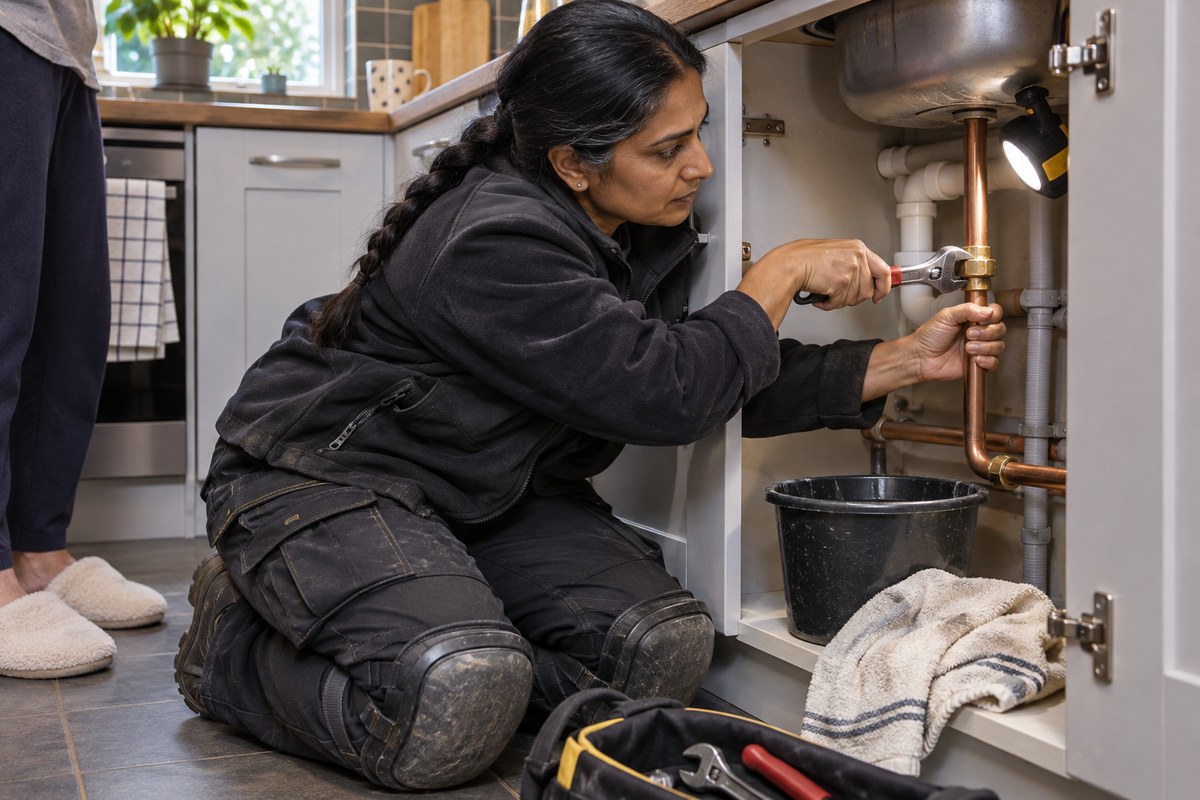
Urgent repairs. There's no right to cancel where the consumer has specifically asked you to visit to carry out urgent repairs or maintenance, such as a burst pipe or a boiler that's stopped. The exception doesn't cover extra services, or goods other than the replacement parts needed for the repair, that you supply on the same visit. Business Companion's example is a plumber who calls to replace a broken immersion heater and offers to fix a dripping tap while there: the tap keeps its cancellation right. Extras sold on an emergency visit are cancellable.
Small off-premises jobs. Regulations 7 and 27 take off-premises contracts where the customer pays £42 or less outside both the information rules and the right to cancel.
Made-to-measure goods. Goods made to the consumer's specifications or clearly personalised have no right to cancel. Business Companion says this may cover double glazed windows made to the measurements of the customer's home, but not a standard-sized unit bought from a trade supplier, or something made by combining stock items.
New buildings. The regulations don't apply to building a new home, or a substantially new building made by converting an existing one, such as a barn conversion. Business Companion says extensions to existing buildings are covered.
Where urgent repairs, made-to-measure goods or another regulation 28 exception applies, you still have to tell an off-premises or distance customer before they're bound that there's no right to cancel, or when they'd lose it.
Supply-and-fit jobs count from delivery
Most trade guidance assumes a service contract, where the 14 days run from the day after the contract is made. Many home jobs aren't one.
A contract to supply goods and fit them is a sales contract under the regulations, and Business Companion gives the supply and fitting of a patio as its example. For a sales contract, regulation 30 says the cancellation period ends 14 days after the day the goods come into the customer's physical possession. Where an order arrives in several deliveries, it runs from the last one.
So a boiler, kitchen or bathroom you supply and fit can be cancelled up to two weeks after the goods arrive, even if the customer accepted a month earlier. If the customer buys the goods and you only fit them, it's a service contract, counted from the day after they agree.
Once the fitting is done, the two types differ again. A customer who asked you to start early loses the right to cancel a service contract once you've fully performed it, provided they acknowledged that when they asked. Under a sales contract they keep the right to cancel and return the goods, but pay for the fitting. Business Companion's example is an aerial delivered and fitted on the same day: the customer pays for the labour but can still remove and return the aerial.
What to give the customer before they agree
For an off-premises contract, the information must reach the customer before they're bound, on paper or, if they agree, on another durable medium such as email. It includes your name and address, the main features of the job, the total price including VAT, payment and performance arrangements and, where the right exists, the conditions, time limit and procedure for cancelling. You must also give a cancellation form. The regulations include a model form, and Business Companion reproduces it. The rest of your terms go in the same document; our guide to terms and conditions for trades covers what to include.
Attach the model cancellation form to the same email, or print it on the back of the quote.
Two further items catch trades out. You must tell the customer that if they ask you to start early and then cancel, they'll pay for the work done. And where there's no right to cancel, or they could lose it, you must say so.
After the contract is made, give the customer a copy of the signed contract or a confirmation before you start the work. For a distance booking, the confirmation goes on a durable medium before the service begins. Our quote template for trade work shows where the cancellation details sit on the quote itself.
Business Companion says that in a dispute, it's for you to prove you gave the information. Keep a copy of what went with each quote and how you sent it.
Starting before the 14 days end
Customers often want you sooner than two weeks. Regulation 36 says you must not begin a service within the cancellation period unless the consumer has made an express request and, for an off-premises contract, made it on a durable medium. A text or an email from the customer works; a nod across the kitchen table doesn't.
The request does three things for you. If the customer then cancels, they pay for the service supplied up to the time they tell you, in proportion to the full contract price, or to the market value if the price is excessive. If the job is labour only and you finish it inside the 14 days, they lose the right to cancel, as long as they acknowledged that when they asked. And it shows you didn't start on your own initiative.
Without the request, or without the cancellation information, the customer bears no cost for the work you did in the cancellation period. Business Companion says the same: start on your own initiative and the customer won't have to pay you if they cancel.
Ask the customer to send the wording below from their own phone or email, in their words if they prefer, and keep it with the job.
For a job booked by phone with no visit, the request doesn't have to be on a durable medium under the regulations, but write it on the job record in the customer's words and confirm it in your booking email. Our callback script for trades covers what to say and send when a callback books paid work.
When a customer cancels in time
A customer cancels by telling you clearly. They can use the model form, but any clear statement counts, including a phone call. A cancellation sent before the period ends is in time, even if you read it later. Ask for it in writing if it came by phone, so you both have the date.
Once they've cancelled, the contract ends for both of you. You must refund everything they've paid without undue delay, and no later than 14 days after the day they told you. Use the same payment method they used unless they agree otherwise, and don't charge a fee for the refund. For goods you supplied, the regulations let you wait until you have the goods back, or proof they've been sent, unless you offered to collect them.
From the refund you can keep the proportionate cost of work done at their written request, worked out as above. If you didn't give the cancellation information, you can't. Our guide to taking a deposit before starting work covers what you can keep when a customer pulls out after the 14 days, which is a different question.
What getting it wrong costs
Leave out the cancellation information and three things happen.
The 14 days don't start. Under regulation 31, the period runs until 14 days after you finally give the information, or for 12 months after it would otherwise have ended if you never do. A customer could cancel a kitchen months after it went in.
The customer owes nothing for the work. Regulation 36 says a consumer who wasn't given the cancellation information bears no cost for work done in the cancellation period, and with the period extended, that can be the whole job.
You may have committed an offence. For an off-premises contract, failing to give the cancellation information is a criminal offence under regulation 19, punishable by a fine.
None of these depends on the customer complaining at the time. They come up when a job goes wrong and the customer, or someone advising them, looks for a way out. That's why the checks are worth making before you quote, not when a cancellation arrives.
Illustrative example: three jobs agreed in one week
This is an invented example to show the checks in use. The firm, customers and figures are made up.
Illustrative example: three home jobs agreed in one week for a heating firm
Week 1, Monday, boiler breakdown: Mrs Ellis rings with no heating and asks for a visit today. Urgent repair she asked for, so no right to cancel the repair. The engineer replaces the fan. She then agrees a magnetic filter for £120, which the repair didn't need, so the filter keeps a right to cancel. He gives her the cancellation wording and form, and she texts asking him to fit it now.
Week 1, Tuesday, bathroom refit: Mr and Mrs Shah agree a £7,800 supply-and-fit bathroom at their kitchen table. Off-premises, sales contract. They're given the information and form, pay a £1,500 deposit and email asking for a start on Monday of week 3. The suite is delivered on Friday of week 2, so the 14 days run from the Saturday after.
Week 3, Wednesday, Shah cancellation: after two days of strip-out, the Shahs cancel by email. They asked in writing to start early, so they pay for the work done: two of eight labour days on a £3,200 labour price, £800. The firm collects the unused suite and refunds £700 to their card within the week.
Week 1, Wednesday, radiator quote: the engineer visits Mr Burke, emails a quote on Thursday, and Mr Burke accepts by email the following Tuesday. On Business Companion's view this is on-premises. The firm gives the cancellation wording with every homeowner quote, so it was already there, and the job is booked for after the date shown.
The Shah job shows why the delivery date matters. Counted from the day they agreed, their period would have ended on the Tuesday of week 3, the day before they cancelled. Counted from delivery, as regulation 30 sets out for a sales contract, it runs to the end of Friday of week 4, so the cancellation was in time.
Write down the date and contract type
Every cancellation question comes back to two facts: how the job was agreed and on what date. Write both down on the day.
On the quote or job record, note the contract type (at the customer's home, by phone or online, at your premises, or a business customer), the date they accepted, the date you gave the cancellation information and how, and the date of any request to start early. For supply-and-fit work, add the delivery date of the goods, because that's when the 14 days start.
If you use a spreadsheet, our quote tracker spreadsheet for trades already has a Cancellation ends column. For supply-and-fit jobs, set it to 14 days after delivery, not 14 days after acceptance.
The regulations apply across the UK. Business Companion's guidance is written for England, Scotland and Wales, and the Citizens Advice page quoted here is for England. This is not legal advice. It summarises the regulations and guidance linked here; if most of your work is agreed in customers' homes, have your quote paperwork checked by your trade body or a solicitor.
Add the cancellation wording to tomorrow's quote
Copy the cancellation wording into your quote template tonight, attach the model form, and save the start-early request as a text you can send. Then decide whether you'll check each job or give the information on every homeowner quote, and write that rule on the first page of your quote pad.
Sources checked for this guide
Cancellation rules checked against the Consumer Contracts Regulations on legislation.gov.uk, Business Companion's trading standards guidance and Citizens Advice. These are the primary sources used in this guide.
- Business Companion, Consumer contracts: off-premises sales
- Citizens Advice, Cancelling building or decorating work
- legislation.gov.uk, regulation 28
- legislation.gov.uk, regulation 30
- legislation.gov.uk, regulation 36
Check your app sends the notice, then agree extras in writing

Free tool
Trade business software checklist: know what you need before you book a demo
List what your quoting app must send with every home quote, including the cancellation notice, before you book a demo.

Read next
Variation form template for trade jobs: agree extra work before you do it
Extra work agreed on a later visit may be a new contract. Record each change on one page.