

When you ring a customer back to agree work over the phone, the law sets your opening line. Regulation 15 of the Consumer Contracts Regulations 2013 says a trader who calls a consumer with a view to agreeing a contract at a distance must say, at the beginning of the conversation, who they are and the commercial purpose of the call. So a callback script starts with your name, your business and why you're ringing, and everything else follows from there.
Below is a callback script for trades to copy, the questions that decide what happens next, what to say if the customer mentions gas or danger, a text to confirm the booking and a short voicemail for when no one answers. It's written for plumbers, heating engineers, electricians, roofers, builders and joiners, and for the partner or office person who makes the calls while you're on the tools. For the wider routine of logging and owning every enquiry, see the guide to stopping missed calls on the job.
Open with your name, business and reason
Regulation 15 is short. If you phone a consumer intending to agree a contract at a distance, you must disclose at the start your identity, the identity of anyone you're calling for, and the commercial purpose of the call. The regulations define a consumer as an individual acting wholly or mainly outside their trade, business, craft or profession, so a homeowner ringing about their own house is a consumer and a letting agency is not.
It applies to contracts made at a distance. Business Companion, the trading standards guidance for businesses, describes these as contracts between a trader and a consumer who aren't together, agreed by phone, post or online, and says there must be an organised scheme for selling at a distance. A callback that only books a free quote visit isn't agreeing any work. A callback that ends with the customer agreeing a paid repair at your call-out rate may well be, if taking bookings by phone is how your business normally works.
Either way, the opening costs you five seconds. It tells the customer which of the firms they rang is calling back, that this isn't a cold call, and what they rang about, so neither of you starts from scratch.
Say it the same way every time: "Hi, is that Mrs Patel? It's Dan from Ridge Roofing. You rang this morning about a slipped tile over the porch, and I'm ringing you back." Name, business, reason, in that order, before any questions.
If an office person or an answering service rings back in your name, they say who they are and who they're calling for: "It's Sam, calling from Ridge Roofing."
Check the record before you dial
Most callbacks go wrong in the first minute, because the person ringing doesn't have the details in front of them. Before you dial, open the enquiry: the name, the number, the address or postcode, what the customer said in their own words, and anything they've sent, such as a photo. Our enquiry form template for trade businesses gives you ten fields for this, so a voicemail, a text and a web form all arrive in the same shape.

Check three more things. First, is this an existing customer? If you fitted their boiler last spring or have a quote out with them, the callback starts from that job, not from scratch. Second, have they already been in touch some other way? A customer who rang, texted and filled in the web form is one enquiry, and three people ringing them back looks disorganised. Third, how long have they been waiting? If you're late, the late callbacks section has the words.
Ring back in order of urgency, then age. Anything marked urgent goes first, then the oldest of the rest. If your greeting promised a time, such as "by 5pm today", the callback routine has to keep it. Our voicemail messages for tradespeople set that promise, and this script is how you keep it.
Ring from the business number if you can, so the customer sees the number they called.
Callback script to copy for a new enquiry
This is the full script for returning a new enquiry. Fill in the brackets from the enquiry record before you dial, and treat the lines as prompts to say in your own words, not a speech to read out. The names in this guide's scripts and example are invented.
If the call wanders, come back to the next part of the script you haven't covered. The aim of a callback is the next step, not a diagnosis.
Anyone who rings back for you, such as a partner or an answering service, gets the same script with your questions filled in and a short list of what they must never promise. Our comparison of call answering services, AI receptionists and text-back sets out what to put in a script for someone else handling your calls.
Questions that decide the next step
The questions on a callback have one purpose: to decide what happens next. That's usually one of four things: a visit to look and price, a repair visit, a request for photos before you decide, or a polite no because it isn't work you do. Ask only what you need to choose between them, and leave the diagnosis for the visit.
These work across trades:
- When did it start, and is it getting worse?
- Can you send a photo or a short video of it?
- Is the property yours, rented, or managed by an agent, and who agrees the cost?
- Is there anything I should know about access, such as parking, a key safe or a dog?
- When are you free for someone to come round?
The enquiry form template lists extra questions for each trade, such as the boiler make and fault code. Ask the ones the first message didn't answer.
Write the answers onto the enquiry record as the customer gives them, not after the call. A note that says "photo coming, landlord to approve, Tuesday or Thursday afternoon" is enough for whoever books the visit.
If the customer starts asking how to fix it, keep to simple steps you're sure of, such as turning the water off at the stopcock, and say the rest waits for the visit. Talking someone through a boiler reset isn't a callback's job.
When the caller mentions gas or danger
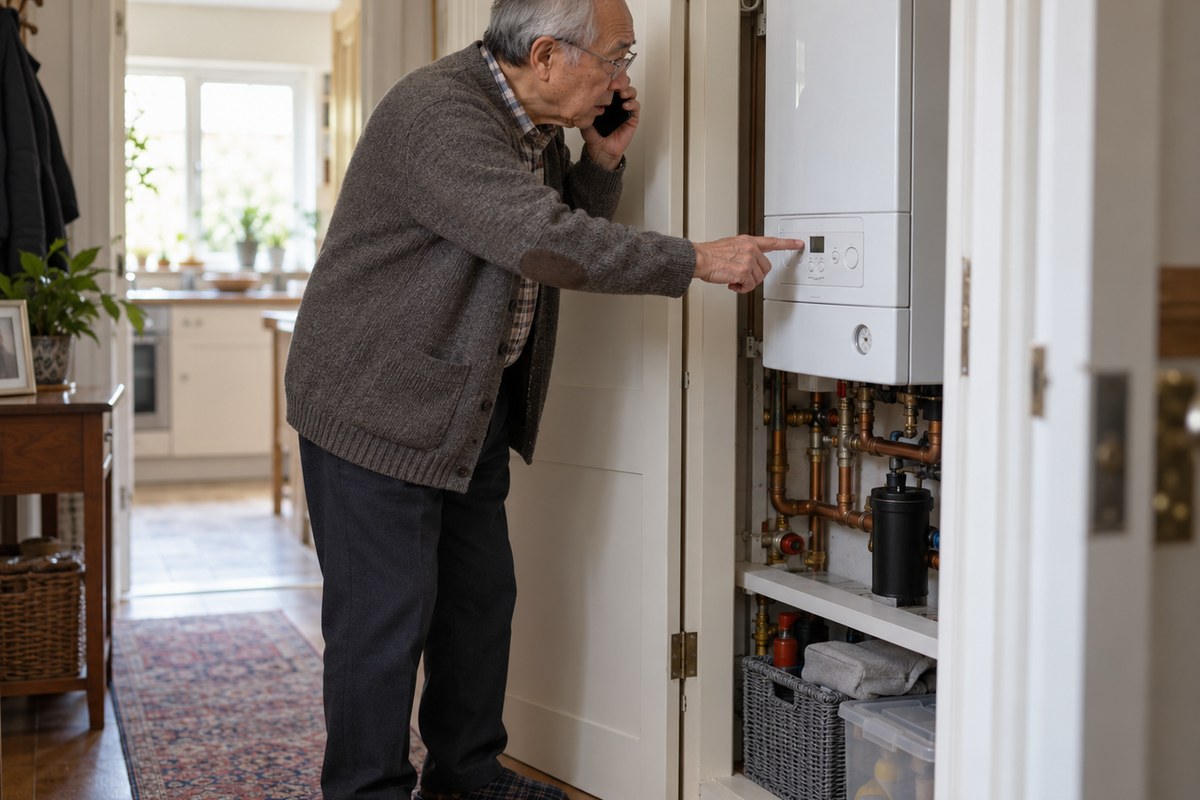
A customer who rang about a noisy boiler may mention a smell of gas halfway through the call, so ask the safety question on every callback, and if the answer is yes, stop the script.
The HSE says that if you suspect a gas leak you should call the gas emergency freephone number, 0800 111 999, open all the doors and windows, and shut off the gas supply at the meter control valve if you know where it is. It gives the same number for an appliance you think is giving off carbon monoxide. In Northern Ireland, HSENI lists the NI Gas Emergency Service on 0800 002 001, available 24 hours.
On the callback, that means saying it plainly: "Please hang up now and ring the gas emergency number, 0800 111 999. Open the doors and windows and don't use the appliance. I'll ring you back in half an hour to see how you're getting on." For a customer in Northern Ireland, give 0800 002 001 instead. Don't try to work out the cause over the phone, and don't offer to come and look before they've rung the emergency number.
For danger that isn't gas, such as water running near electrics, a ceiling bulging with water or a burning smell from a consumer unit, tell the customer to keep away from it and, if anyone is in danger, to ring 999. Then say straight away whether you can get there. If you can't, say so, so they ring another firm now instead of waiting on you.
Promise only what your diary keeps
The end of the call is where most callbacks lose trust. A customer who hears "I'll get someone out tomorrow" plans their day round it, and remembers if no one comes. Say what happens next and when, and only promise what you're sure the diary allows.
If you're not the person who books the work, don't give a date. Say who will ring with one and by when: "Our office will ring you by 3pm with a day for the visit" is a promise you can pass on and the office can keep. If you are booking it, give a window, not an exact time, and say how you'll let them know if it slips.
Prices are the other trap. Customers often ask "roughly how much?" before anyone has seen the job. If you give a figure, give a range, call it an estimate, and say what it depends on, or the number you said becomes the number they expect. Our guide to whether to give a quote or estimate explains what each one holds you to.
Fixed charges are different. If you have a call-out charge, or charge for a quote visit, say so on the call and say how much, so the invoice holds no surprises.
Confirm every booking in writing
Send a confirmation for every booking, paid or not, straight after the call and before you ring the next customer. It gives the customer your number and the arrival window in one place, and it gives you a record of what was agreed.
For a free quote visit, this text is all you need. For paid work agreed with a homeowner on the call, send it as well as the full written confirmation described in the next section, by email, so the customer has everything before you arrive.
Keep the text to the booking. An offer or a line about your boiler cover plan turns an information message into marketing, which the section on sales offers explains.
Booking paid work over the phone
When a callback ends with a homeowner agreeing to paid work, such as a repair visit at your call-out rate, the call may have made a distance contract. Business Companion's guide says that once you've entered into one, you must give the consumer confirmation of the contract on a durable medium, such as paper or email, before the service begins. The confirmation has to include the full list of information the regulations require, including your details, the total price or how it will be worked out, and the customer's cancellation rights, unless you've already given them all of that on a durable medium.
For a service, the cancellation period is 14 days, starting the day after the contract was made. If the customer wants you to start within those 14 days, Business Companion says they must expressly request it. If they then cancel part-way through, they pay for the service supplied up to the point they told you, in proportion to the full price. They don't have to pay at all if you didn't give them the cancellation information and tell them they'd pay for work done in that time, or if they never asked you to start early.
There's one exception that matters to emergency trades. There's no right to cancel where the consumer has specifically asked you to call to carry out urgent repairs or maintenance. Business Companion adds that this doesn't cover other goods or services provided on the same visit. If you fix the urgent leak and the customer then asks you to replace a dripping tap while you're there, the tap keeps its cancellation right.
So a callback that books paid work with a homeowner ends with the request to start early written on the record in the customer's words, and a written confirmation sent before you arrive. Our quote template guide covers the cancellation notice and form, and the same wording works in a booking email.
The regulations apply across the UK. Business Companion's guide is written for England, Scotland and Wales. This is not legal advice. It summarises the regulations and guidance linked here; if most of your work is booked by phone, read the full guide or ask your trade body.
When no one answers your callback
Plenty of callbacks go to voicemail, because the customer is at work or doesn't pick up numbers they don't know. Leave a short message that names your business and the problem, says when you'll try again, and gives them an easy way back to you.
Leave out the address, the price and anything personal. A voicemail can be played by whoever picks up the phone, and a landline in a shared house is heard by everyone in it. Send a text saying the same thing.
Agree how many tries you'll make and stick to it. A common pattern is three attempts over two working days, at different times of day, with a text after the first. Then close the enquiry with the reason "no contact" on the record. Five calls in an afternoon put customers off; one call and giving up loses work you'd have won.
Late callbacks and customers who went elsewhere
Sometimes you'll ring back later than you promised. Say so in the first sentence, without a long excuse: "Hi, it's Dan from Ridge Roofing. I said I'd ring you yesterday about the porch tile and I didn't, sorry about that. Are you still looking for someone?" The question at the end matters. It lets the customer tell you straight away if they've booked someone else, so neither of you wastes time.
If they have, thank them and close it: "No problem, thanks for letting me know. If anything changes, you've got our number." Then write the reason on the enquiry record. When "went elsewhere, called back a day late" shows up five times in a month, it's your callback times that need changing, not your prices.
Existing customers chasing a job need your name, business and the job: "It's Jo from Smith Plumbing, about the bathroom at 14 Elm Road." They usually want to know when someone is coming. If you don't know yet, say when you will.
Keep sales offers out of the callback
A callback the customer asked for is about their enquiry, and it's best kept that way. The ICO describes information-only contact, such as an appointment reminder, as a service message, which doesn't count as direct marketing, and says that adding promotional content to one, even as a side point, makes it direct marketing. Treat the callback the same way: answer the enquiry, book the next step, and stop.
Selling something else on the call, such as an annual service plan or boiler cover, makes it a marketing call, and different rules apply. The ICO says you can't make live marketing calls to anyone who has told you they don't want your calls, or to a number registered with the Telephone Preference Service (the TPS), or with the Corporate Telephone Preference Service for businesses. You won't know during a callback whether the customer's number is registered, so the safe habit is to keep offers off the call. If a customer asks about a service plan themselves, answer the question; that isn't an unsolicited sales call.
This is not legal advice. It summarises ICO guidance on the marketing rules, which apply across the UK.
Example: a morning of callbacks
This is an invented example to show the script in use. The business, customers and times are made up.
Illustrative example: Monday morning callbacks for a two-person heating firm
Business: Hollis Heating, a heating engineer on the tools and a partner who makes the callbacks from home on weekday mornings
8.30am, before dialling: four enquiries on the record from Friday and the weekend; one marked urgent, no heating at the home of a customer in her eighties
8.35am, Mrs Okafor's daughter, urgent: opening line, address checked, boiler showing a fault code, no smell of gas; repair visit booked for 11am to 1pm today at the call-out rate; the daughter asks for the engineer to come today, and the partner writes that request on the record in her words
8.45am: confirmation email sent to the daughter with the visit window, the call-out rate and the firm's booking terms
8.50am, Mr Reid, new enquiry for a boiler replacement quote: three questions asked, photos of the boiler and flue requested; free quote visit booked for Thursday, 2pm to 4pm; confirmation text sent
9.05am, Ms Lowe, radiator not heating up: no answer; voicemail left saying the partner will try again at 12.30pm; text sent with the same time
9.10am, Mr Grant, left a message on Friday at 1pm: the engineer didn't get to it on Friday afternoon; the partner opens by saying sorry for the late callback; he has booked someone else; closed as went elsewhere, Friday message not returned the same day
12.30pm, Ms Lowe: second attempt answered; quote visit booked for Friday morning; confirmation text sent
The urgent enquiry went first and was booked within a quarter of an hour. Mr Grant's note went on the record with its reason, so at the end of the month the firm could count how many Friday afternoon messages slipped to Monday. If that count keeps rising, the fix is a Friday afternoon voicemail check, not a better script.
Callback mistakes that lose the job
Ringing without the record. "Sorry, what was it you called about?" tells the customer their message went nowhere.
Starting with questions. Asking "what make is the boiler?" before saying who you are leaves the customer guessing who's calling.
Promising a time someone else has to keep. "We'll be there first thing" from the person making callbacks, when the engineer's diary is full, sets up a complaint. Say who will confirm the time, and when.
Pricing blind. A figure given on the phone before anyone has seen the job becomes the figure the customer expects.
No written confirmation. If the booking only exists in two people's memories, it will be remembered two different ways. Send the text or email before you ring the next customer.
Not writing it down. The call ends, the phone rings again, and the details of the last call are gone. Update the record before you dial again.
Make tomorrow's first callbacks from the script
Copy the script into your phone or print it, fill in your business name and the questions for your trade, and keep it next to the enquiry record. Tomorrow, make the first three callbacks from it, in order of urgency, and send a confirmation after each one before you dial the next. Before you finish for the day, look at what you wrote on the record and change any line of the script that didn't sound like you.
Fit callbacks into your day, then put the price in writing

Free tool
Call handling checklist: a printable daily routine so every trade enquiry gets a callback
Set fixed times each day to clear messages, give every enquiry an owner and make the callbacks.
Read next
Quote template for trade work: a printable quote customers can say yes to
When a callback books a quote visit, put the price, scope and cancellation details on one page.
Sources checked for this guide
Phone contract, gas emergency and marketing call points checked against the Consumer Contracts Regulations 2013, Business Companion, HSE, HSENI and ICO guidance. These are the primary sources used in this guide.